
Treats: CO and hydrocarbons (HC)
DOC (Diesel Oxidation Catalyst)
A precious-metal oxidation catalyst that converts carbon monoxide and hydrocarbons in diesel exhaust, and helps the DPF downstream to regenerate.
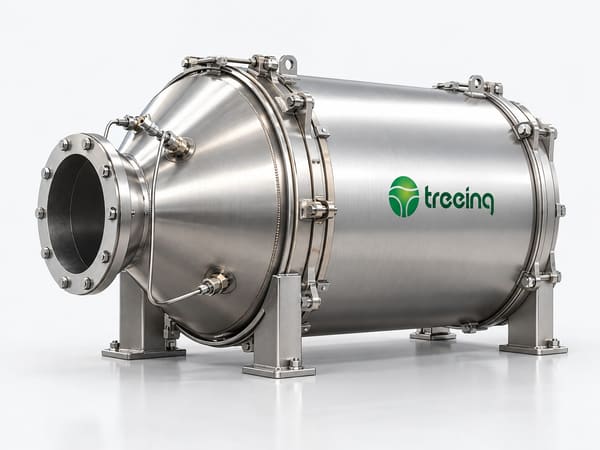
- Treats
- CO and hydrocarbons (HC)
- Engines
- Diesel gensets up to 5 MW
- Substrate
- Flow-through honeycomb with precious-metal coating
- Position
- First stage, upstream of DPF and SCR
How the DOC works
- 1
Flow-through substrate
Exhaust flows through open honeycomb channels coated with a precious-metal catalyst. It adds little backpressure.
- 2
Oxidation
Above its light-off temperature, the catalyst oxidizes CO, hydrocarbons and the soluble organic fraction (SOF) into CO₂ and water.
- 3
Support for the DPF
The DOC raises exhaust temperature and produces NO₂, which helps burn off soot in the DPF downstream.
What the system includes
- Catalyst housing with coated honeycomb substrate
- Inlet and outlet temperature sensors
- Integrated module with DPF and SCR, when the project needs all three
Where it is used
- Fuel
- Diesel
- Typical use
- CO and HC limits, odour, and as the first stage before a DPF
- Combined with
- DPF and SCR in an integrated aftertreatment module
The catalyst needs exhaust above its light-off temperature. Tell us the exhaust temperature at typical load so we can confirm it will work for your duty cycle.
Specifications
Every system is sized for the engine and site, so we do not publish standard sizes. Send your engine data sheet and emission or noise limit, and we reply with a configuration and the values we can achieve.
What we need to size it
- Engine make, model and rating
- Exhaust temperature at typical load
- CO and HC limits, if any
- Whether a DPF or SCR is also planned
- Space available in the exhaust line
Request a quote
Send the engine model, fuel and the emission limit for your site. An engineer replies with a first assessment.
- Engine make, model and number of units
- Fuel type, and a gas analysis for biogas
- NOx limit with reference O₂, and any noise limit
- Site layout or exhaust drawings, if available
Prefer to call or write directly?