
Treats: Soot and black smoke (PM)
DPF (Diesel Particulate Filter)
A wall-flow filter that captures soot from diesel exhaust and removes visible black smoke. The filter is cleaned in place by regeneration.
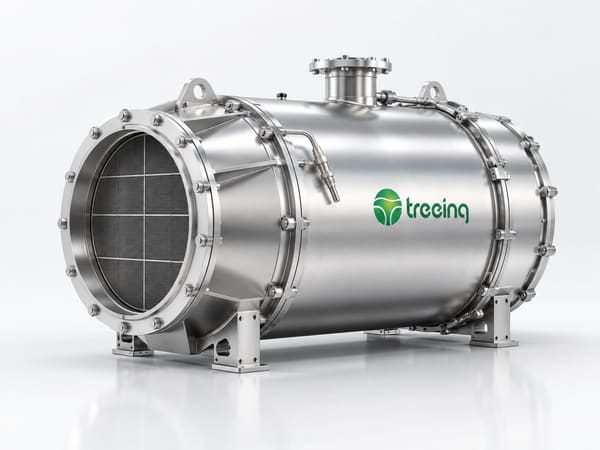
- Treats
- Soot and black smoke (PM)
- Engines
- Diesel gensets up to 5 MW
- Substrate
- Wall-flow, cordierite or silicon carbide (SiC)
- Cleaning
- Passive or electrically heated regeneration
How the DPF works
- 1
Filtration
Channels in the substrate are plugged at alternate ends, so exhaust has to pass through the porous walls. Soot stays behind.
- 2
Load monitoring
Differential pressure across the filter shows how much soot has built up.
- 3
Regeneration
Collected soot is burned off. Passive regeneration uses exhaust heat with a DOC upstream; electrically heated regeneration is used when the exhaust stays too cool.
- 4
Ash cleaning
Ash that does not burn collects slowly and is removed at service intervals.
What the system includes
- Filter housing with wall-flow substrate
- DOC upstream, where passive regeneration is used
- Differential pressure and temperature sensors
- Electric heating for regeneration, where the duty cycle needs it
- Control and alarm signals for the site control system
Where it is used
- Fuel
- Diesel
- Typical use
- Standby and prime power gensets with visible smoke or PM limits
- Combined with
- DOC upstream; SCR downstream when NOx is also limited
Regeneration depends on how the genset runs. Tell us the load profile and running hours, for example standby with monthly tests or continuous prime power.
Specifications
Every system is sized for the engine and site, so we do not publish standard sizes. Send your engine data sheet and emission or noise limit, and we reply with a configuration and the values we can achieve.
What we need to size it
- Engine make, model and rating
- Load profile and running hours
- Exhaust temperature at typical load
- Fuel sulfur content
- Smoke or PM limit for the site
Request a quote
Send the engine model, fuel and the emission limit for your site. An engineer replies with a first assessment.
- Engine make, model and number of units
- Fuel type, and a gas analysis for biogas
- NOx limit with reference O₂, and any noise limit
- Site layout or exhaust drawings, if available
Prefer to call or write directly?